Introduction
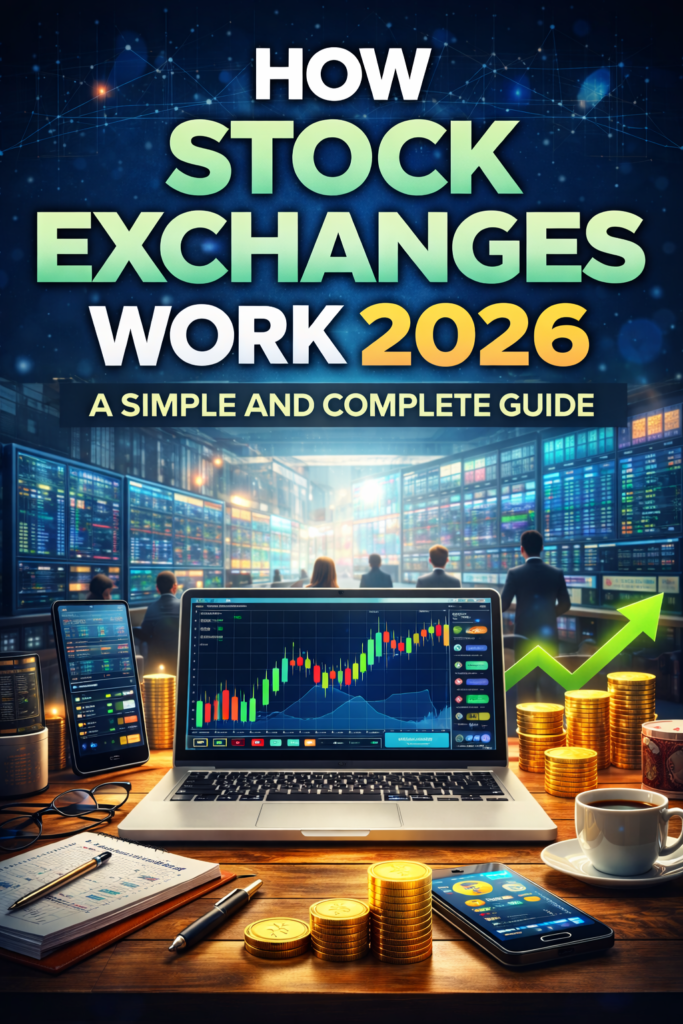
Stock exchanges are the backbone of the global financial system. Every day, trillions of dollars move through these marketplaces as investors buy and sell shares, bonds, and other securities. Yet for many people, understanding how stock exchanges work remains confusing.
In 2026, stock exchanges are more digital, faster, and globally connected than ever before. This guide explains how stock exchanges work, breaking down complex processes into simple concepts for beginners and intermediate investors alike.
At financetop10.com, our goal is to make investing knowledge accessible, practical, and easy to understand.
What Is a Stock Exchange?
A stock exchange is an organized marketplace where:
- Publicly listed companies sell shares
- Investors buy and sell securities
- Prices are determined through supply and demand
Stock exchanges provide transparency, liquidity, and regulation—essential elements for investor confidence.
Why Stock Exchanges Exist
Stock exchanges serve two main purposes:
1. Helping Companies Raise Capital
Companies list shares to raise money for:
- Expansion
- Research and development
- Debt reduction
In return, investors gain partial ownership. Understanding how stock exchanges work helps investors see why companies rely on them to fund growth.
2. Providing Investors With Liquidity
Investors can buy or sell shares easily, rather than holding them indefinitely.
How Trading Actually Works
Step 1: Placing an Order
An investor places an order through:
- An online brokerage platform
- A mobile trading app
Orders specify:
- Buy or sell
- Quantity
- Price (market or limit order)
Step 2: Order Matching
Modern stock exchanges use electronic matching engines.
- Buy orders are matched with sell orders
- Prices are determined by the best available bids and offers
- Trades execute in milliseconds
Human traders are no longer involved in most transactions.
Step 3: Trade Execution and Settlement
Once matched:
- The trade is executed instantly
- Ownership transfers during settlement (usually within 1–2 days)
- Funds and shares are exchanged electronically
Types of Orders Investors Use
Understanding order types is critical in 2026:
- Market Order – Executes immediately at current price
- Limit Order – Executes only at a specified price
- Stop Order – Triggers a trade when price reaches a level
Each order type offers different levels of control and risk.
What Determines Stock Prices?
Stock prices are influenced by:
- Company earnings
- Economic data
- Interest rates
- Investor sentiment
- Global events
Prices constantly adjust as new information enters the market.
Role of Stock Exchanges in Global Finance
In 2026, stock exchanges are deeply interconnected. News in one country can instantly impact markets worldwide.
Key global functions include:
- Price discovery
- Capital allocation
- Risk distribution
This connectivity allows investors to diversify internationally more easily than ever.
Traditional vs Fully Electronic Exchanges
Older exchanges relied on physical trading floors. Today:
- Most trading is fully electronic
- Physical floors exist mainly for symbolic or ceremonial purposes
- Speed and automation dominate market efficiency
How Retail Investors Access Stock Exchanges
Most individuals access exchanges through:
- Online brokers
- Mobile investment platforms
These intermediaries handle:
- Compliance
- Clearing
- Reporting
This makes investing more accessible to everyday users globally.
Risks Investors Should Understand
Even with modern systems, stock exchanges involve risks:
- Market volatility
- Systemic shocks
- Behavioral biases
Understanding how stock exchanges work helps investors manage expectations and strategy.
The Future of Stock Exchanges Beyond 2026
Looking ahead, exchanges are expected to:
- Use more AI-driven trading systems
- Increase transparency through advanced data analytics
- Expand access to emerging markets
Stock exchanges will remain essential—but continue evolving rapidly.
FAQ Section
Are stock exchanges only for large investors?
No. Retail investors can participate easily through online platforms.
Do stock exchanges operate 24/7?
Most follow local trading hours, though global markets allow near-continuous access.
Is stock trading risky for beginners?
Yes, trading comes with risks like market volatility. However, understanding how stock exchanges work and following best practices can help beginners manage risk and trade confidently.